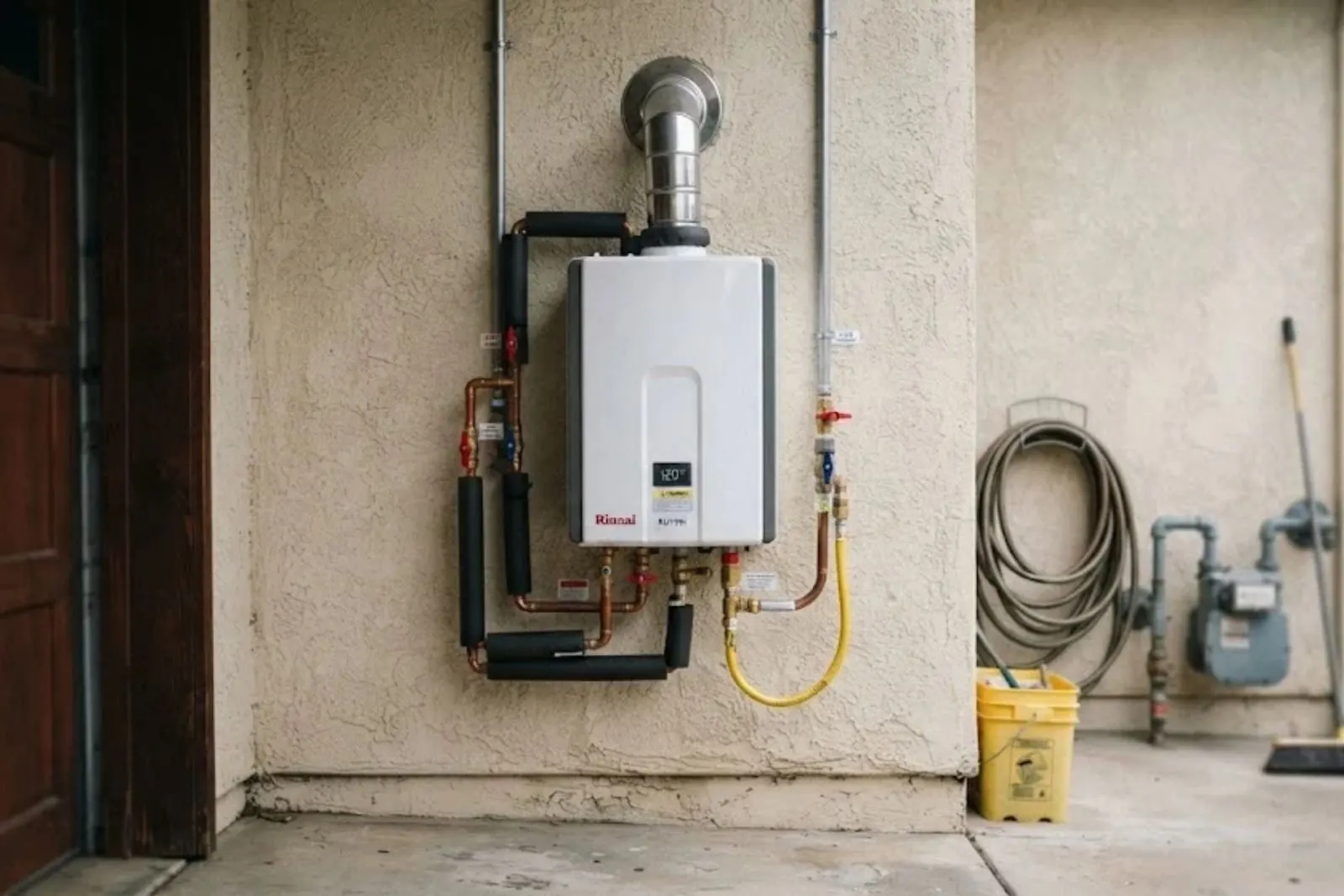
Tankless water heater service in Chelsea, MA covers installing on-demand heaters, repairing error codes and cold-water sandwiches, and flushing scale from the heat exchanger. These units heat water as it flows, so they have no tank to run out or to leak onto the floor.
The catch is the building. Gas tankless models need a larger gas line and a dedicated vent, and electric models draw a heavy circuit. We check both before we quote, because surprises on install day cost more than a short visit up front.
What a tankless unit needs from a Chelsea building
Many older Chelsea homes were piped for a small tank heater. A tankless unit asks for more gas volume, so the meter, the line from the meter and the pipe inside the building may all need upgrading.
Venting is the second hurdle. Tankless gas units use a sealed vent that must exit through a wall or roof with required clearances from windows and neighboring openings, and not every basement wall offers a legal path.
Common tankless problems and fixes
| Symptom | Likely cause | Remedy |
|---|---|---|
| Error code and no heat | Ignition, flame sensor or vent fault | Clean or replace sensor, check venting |
| Lukewarm or fluctuating water | Scale on the heat exchanger | Descale flush |
| Cold water in the middle of a shower | Low flow rate below the unit's minimum | Clean filter, check fixtures, adjust settings |
| Slow hot water arrival | Long pipe run from the heater | Recirculation loop or point-of-use option |
| Unit shuts down in winter | Condensate drain freezing | Reroute or insulate the condensate line |
If your heater is a tank and failing, the better move may be a replacement with a standard or hybrid unit. We tell you if a tankless conversion does not make sense for your space.
Soft water helps, but flushing still matters
Chelsea receives MWRA water at about 1 grain per gallon of hardness, which is soft. That means scale builds more slowly than in hard-water areas, but the heat exchanger still gets deposits over time and sediment still collects in the filter screen.
We recommend a flush on a schedule that fits your use and your manufacturer's guidance. A flush is quick and costs far less than a heat exchanger replacement.
How a tankless installation goes
- SurveyWe check gas meter capacity, pipe size, venting path and electrical supply.
- Quote and permitYou get a written scope, and a licensed plumber files the local permit.
- InstallWe mount the unit, run gas, water and vent, and add isolation valves for later flushing.
- CommissionWe check gas pressure, combustion, flow and temperature, then show you the controls.
Thinking about going tankless?
Call and we will survey the space, check the gas line and give you a clear price.
Condos, multi-unit buildings and shared stacks
In condos and multi-family buildings, a tankless unit may have to vent through a common wall or stack. Building rules, shared utilities and neighbor clearances all apply, so we work with the owner or association when that is the case.
Gas meters in multi-unit buildings are often shared or small. A larger gas load can mean the utility has to upgrade service, which adds time to the project.
What a tankless job depends on
What moves the price
Planned upgrades are not covered by insurance. You get a clear price before work starts. Call (617) 752-0573.
Tankless water heater questions
Yes. Dispatch is open 24/7 and a licensed plumber can diagnose error codes and no-heat calls after hours.
That depends on pipe size and meter capacity. We measure and calculate load before recommending a unit.
Follow the manufacturer's schedule. In soft water areas like Chelsea the interval can be longer, but an annual check is a reasonable baseline.
Sometimes, when venting and gas are ready. Many conversions need a survey, a permit and a second visit.
It saves floor space and never runs out of hot water, though upfront cost and installation limits matter. We help you compare it with a compact tank.
Standards and sources
Venting, gas sizing and condensate drains follow the Uniform State Plumbing Code (248 CMR 10.00) and the manufacturer's installation standards. MWRA publishes the water quality data for Chelsea's supply. The code is published by the Commonwealth at 248 CMR 10.00, the Uniform State Plumbing Code.
Written by the Chelsea Express Plumbing team. Last updated 2026-11-16.