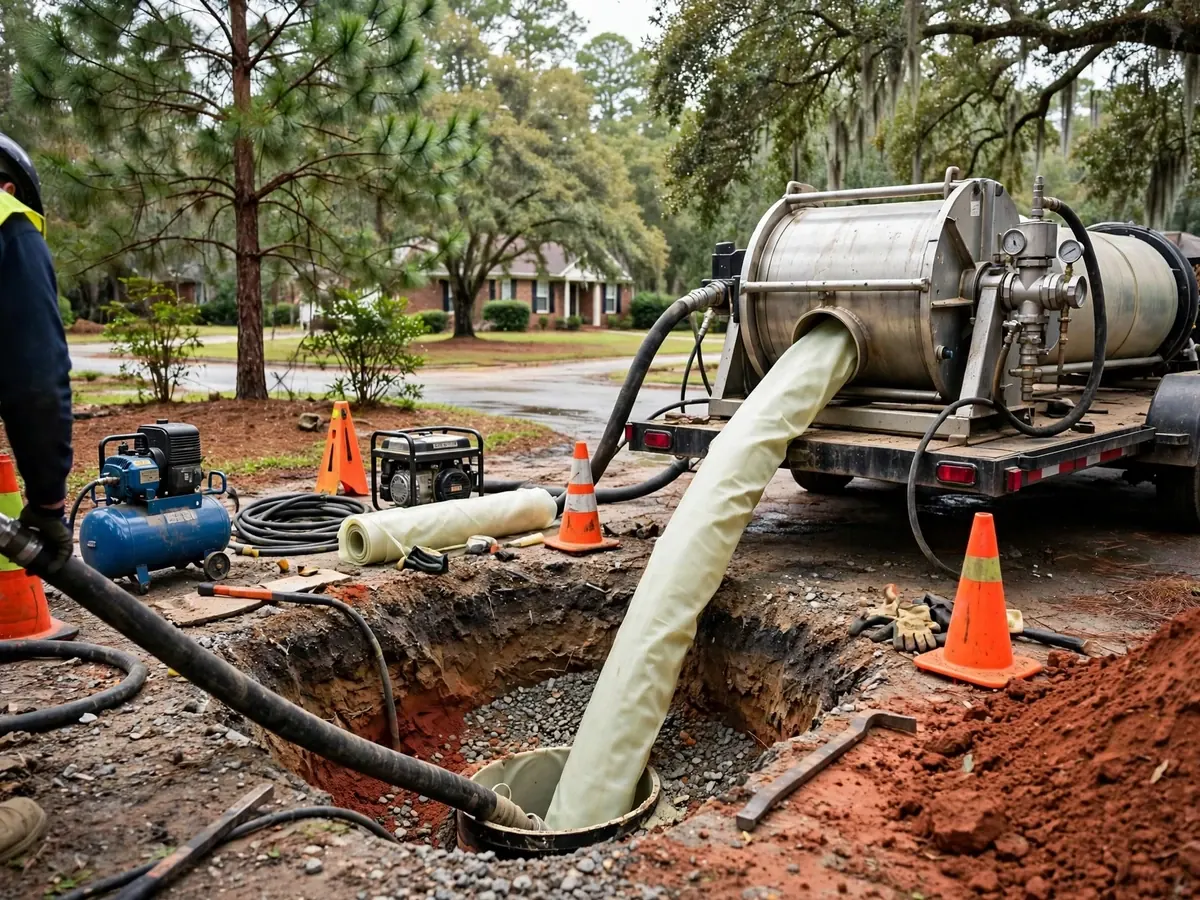
Sewer pipe lining repairs a damaged line from the inside. A resin-soaked liner is pulled into the old pipe and cured until it hardens into a new pipe within the old one. There is little or no digging, and it can be a good fit where the old line runs beneath a basement slab, a driveway or a stairwell.
It is not a cure for every sewer problem. Lining works on pipe that is structurally able to hold the liner, and the first step is always a camera look at what is really in the ground.
What lining fixes and what it does not
Liners seal cracks, small holes, root intrusions at joints and rough interior walls. They also reduce the number of joints where roots can enter. A cured liner is smooth, so flow improves and buildup is slower.
Liners cannot repair a collapsed section, a major belly that holds water or a line that has separated by a large gap. In those cases the pipe must be dug and replaced, and sewer line repair is the right path.
Lining versus digging
| Factor | Lining | Open-cut replacement |
|---|---|---|
| Disruption | Small access points | Trench through yard, floor or street |
| Best for | Cracks, roots, joints | Collapse, large bellies, separated pipe |
| Flow | Smooth interior, slightly smaller diameter | New full-size pipe |
| Surface restoration | Little | Concrete, landscaping or paving to restore |
| Permit | Usually needed | Needed |
Why the camera comes first
A liner needs a clean, open pipe. Before lining, we clean the line with a cutter or a jetter, then run a camera to check the diameter, the joints and the path. If the pipe is crushed or offset, the liner will not pass.
The camera also gives you a recording of the line before and after. That record helps if you sell the property or deal with an insurer, and a sewer inspection is the usual starting point.
How a lining job runs
- Clean the lineRoots and scale are cut away so the liner can seat tightly.
- Inspect with a cameraWe confirm the pipe can take a liner and mark any bends and joints.
- Install the linerA resin-coated tube is inverted or pulled into the pipe and pressed against the wall.
- Cure and reopen lateralsThe resin hardens and cutters reopen any side connections, then we run a final camera pass.
Older Chelsea pipes and why lining is common here
In tight Chelsea lots, a sewer lateral often runs under a basement slab, a porch or a neighbor's shared wall. Digging means breaking concrete and moving utilities, so lining saves time and disruption where the pipe is still in one piece.
Clay, cast iron and old Orangeburg pipe all show up in older neighborhoods. Each fails differently, and the right method depends on what the camera shows.
Chelsea local note
About 70 percent of Chelsea's sewers are combined with stormwater, and the city has been working on separating them. A damaged private lateral lets groundwater and roots in and adds to flow during storms.
Massachusetts requires a plumbing permit for sewer work, and only a licensed plumber can pull it. Ask the local plumbing inspector what they need for your address. Source types: city sewer information and state plumbing licensing guidance.
Questions to ask before you hire anyone to line a pipe
Ask to see the camera footage that justifies lining instead of replacement. Ask what the liner is made of, what the manufacturer says about its service life and whether the installer will provide a final inspection recording. A contractor who cannot show the footage should not be lining your pipe.
Ask who pulls the permit and who is responsible if the liner fails to cure properly. Written answers protect you if the building changes hands later.
Sharing a lateral with a neighbor
In dense blocks, two buildings sometimes share a single lateral to the street. That means one lined section can serve both properties, and one owner's clog is the other's backup. Agree on the scope and the split of responsibility before work starts, in writing.
A camera view from both buildings also helps. It shows where the lines join and whether one side has defects the other does not.
Records to keep after the work
Keep the permit, the before and after camera recordings and the written scope. If you sell, a buyer's inspector will want to see them, and an insurer may ask for them after a claim. Store a copy somewhere other than the laptop you use every day.
If the lateral is shared, give the neighbor a copy as well. It keeps everyone clear about where the liner starts and ends.
Not sure if your pipe can be lined?
A camera inspection will show the real condition and your options.
Sewer lining questions
Manufacturers describe decades of service life when the host pipe was sound at installation. Your plumber can explain what applies to the product used.
Slightly, because the liner has a wall thickness. Most residential lines still carry flow well because the interior is smooth.
A small belly may be acceptable, but a deep one that holds water will keep holding it. The camera and a level check tell us.
It depends on who owns each section. Confirm with the city and the other owners before work.
It stops problems caused by cracks and roots in your lateral. It will not fix a backup caused by overloaded street sewers, where a backwater valve may help.
Related pages
Nearby service areas: Everett, Revere. Related services: Sewer Inspection, Sewer Line Repair.
Standards and sources
Camera inspection findings feed repair work that falls under the Uniform State Plumbing Code (248 CMR 10.00). The code is published by the Commonwealth at 248 CMR 10.00, the Uniform State Plumbing Code.
Written by the Chelsea Express Plumbing team. Last updated 2026-11-16.